

Leveraging AI for Successful Reimbursements in Healthcare
Imagine a world where every new technology or innovation introduced into the market is subjected to rigorous scrutiny and evaluation before it is accepted as the norm. In such a world, clinical utility would be the guiding principle for any technology seeking to improve healthcare. Clinical utility is the ability of a technology to improve clinical outcomes and enhance patient care. When it comes to artificial intelligence (AI) in healthcare, demonstrating its clinical utility is key to convincing stakeholders of its value. In this article, we will explore the importance of demonstrating the real use of AI and how it can lead to further successful reimbursements.
Clinical Utility of AI
So, how do we demonstrate the clinical utility of AI in medicine? One way is through clinical trials, which involve testing the technology in a controlled setting to determine its efficacy and safety. Real-world studies, on the other hand, involve evaluating AI in actual clinical practice to see how it performs in the real world. Both approaches are essential in demonstrating the usage of AI and can provide valuable insights for healthcare providers and policymakers alike.
Fortunately, there have already been successful demonstrations of the clinical utility of AI in various medical fields. For example, AI has been shown to improve diagnostic accuracy and reduce diagnostic errors in radiology, pathology, and dermatology. In cardiology, AI has been used to predict heart failure and improve patient outcomes. In neurology, AI has been used to identify early signs of Alzheimer's disease. These are just a few examples of how AI makes a real difference in healthcare, and we can expect to see even more in the future.
Getting reimbursements in healthcare for new technologies can be a challenging endeavor, primarily due to the tedious and complicated procedures involved, compounded by the absence of a clear structure. However, there are effective strategies to navigate this complex landscape:
- Conduct thorough research: Understand the reimbursement landscape, including relevant regulations, policies, and payer requirements specific to your technology and target market.
- Gather clinical evidence: Generate robust clinical data and evidence to demonstrate the effectiveness and cost-effectiveness of your technology compared to existing alternatives.
- Identify appropriate reimbursement codes: Determine the applicable reimbursement codes, such as Current Procedural Terminology (CPT) codes or Healthcare Common Procedure Coding System (HCPCS) codes, that align with your technology's features and use cases.
- Engage with key stakeholders: Build relationships with payers, providers, clinicians, and patient advocacy groups to understand their perspectives, gain support, and address any concerns related to reimbursement.
- Develop a compelling value proposition: Clearly articulate the value proposition of your technology, highlighting how it improves patient outcomes, reduces healthcare costs, and aligns with payer and provider goals.
- Stay updated on policy changes: Monitor changes in healthcare policies, regulations, and payer guidelines to adapt your reimbursement strategy accordingly.
Reimbursement Landscape for AI in the US
🔍As we delve deeper into the financial aspect of the reimbursement landscape for AI in healthcare, we see that providers face limited options for receiving reimbursements for AI in medical practice. The financial implications of this are significant. The global AI in healthcare market size was estimated to be $2.1 billion in 2020 and is projected to grow to $45.2 billion by 2026, with the North American market accounting for the largest share. However, without clear reimbursement guidelines and policies, providers may be hesitant to invest in AI technology, which could slow down the growth of the market.
In addition to the lack of standardization, another challenge that healthcare providers face is the cost of implementing AI technology. The upfront costs of implementing AI in healthcare can range from $50,000 to $100 million, depending on the size of the organization and the scope of the project. This can be a significant barrier for smaller healthcare providers who may not have the financial resources to invest in AI technology without the promise of future reimbursement.

🔍 In recent years, the number and scope of artificial intelligence-enabled devices have grown exponentially, marking a historic milestone in healthcare. The US Centers for Medicare & Medicaid Services (CMS) recently announced coverage provision for AI-specific CPT code and the creation of the first New Technology Add-On Payment (NTAP) for an AI device, which is a significant development in the payment for AI-enabled services.
As a result, payers are beginning to reimburse AI services for the use of image-based AI tools. The paper highlights the AI devices currently reimbursed by US Medicare and proposes five potential payment strategies for AI in medicine.
These strategies include forgoing separate reimbursement of AI devices, incentivizing outcomes over volume, utilizing advance market commitments for new AI solutions, providing time-limited reimbursements for new AI applications, and rewarding interoperability and bias mitigation.
One additional strategy could be a combined payment based on a percentage of cost savings and quality improvement dividends, given AI's potential to reduce diagnosis and therapy time. It is important to note that a combination of these strategies can be used to create a meta-strategy. The authors suggest that the strategic design of AI and its payment can improve patient outcomes while maximizing cost-effectiveness and equity, which is crucial in a healthcare system that is full of inefficiencies.
Therefore, AI alone should not be the only focus to achieve the desired outcomes, but rather a combination of administrative measures should also be implemented.

Reimbursement Landscape for AI in the EU
🔍In Europe, the reimbursement of AI in healthcare is still in its early stages, but progress is being made. In some countries, national healthcare systems have already started reimbursing AI services. For example, in France, the government has created a new reimbursement category for AI-based medical devices, which allows healthcare providers to bill national health insurance for AI-related expenses.
In other European countries, AI-based medical devices are being evaluated and tested for clinical effectiveness and cost-effectiveness by national health technology assessment agencies. These evaluations are important for determining whether a technology is reimbursed by national healthcare systems.
In addition, the European Union has established the European Health Data Space, which aims to provide a secure and standardized framework for sharing healthcare data across Europe. This initiative could help to accelerate the adoption of AI in healthcare by enabling healthcare providers to access and analyze large datasets to improve patient outcomes.
However, there are still challenges that need to be addressed to ensure the widespread adoption of AI in healthcare across Europe. These challenges include the need for standardized data collection and sharing, as well as the development of ethical guidelines for the use of AI in healthcare. Moreover, physicians and healthcare professionals need to be trained on how to use AI tools effectively and integrate them into their clinical workflows.
The Link between Clinical Utility and Reimbursements
As we've discussed, healthcare providers face significant challenges in seeking reimbursements for AI in medical practice. However, demonstrating the clinical utility of AI can pave the way for successful reimbursement. When providers can prove that their use of AI technology leads to improved patient outcomes and reduced costs, payers are more likely to provide reimbursement.

Demonstrating the clinical utility of AI is essential for healthcare providers seeking reimbursements for their AI investments. For example, AI-powered radiology tools that help providers detect and diagnose lung nodules have shown significant clinical utility, resulting in successful reimbursement claims. The use of AI in lung cancer screening which can lead to a rate of 40 - 60% reduction in false-positive findings, can save an estimated $1.2 million in unnecessary diagnostic workups per 1,000 patients screened.
Similarly, AI-powered breast cancer screening tools show clinical utility in improving accuracy and efficiency, leading to successful reimbursement claims. An AI-powered mammography system that can improve cancer detection rates by only 8%, results in an estimated $21.6 million in additional health benefits and savings over three years.
These examples demonstrate how demonstrating clinical utility can lead to successful reimbursement for AI in healthcare. By providing evidence of the clinical and financial benefits of AI, healthcare providers can justify their investments and secure reimbursement for their AI initiatives.
Are you a healthcare provider looking to integrate AI into your practice but struggling to obtain reimbursements? By using our products, you can improve patient outcomes while also increasing revenue for your practice. Don't miss out on this opportunity to innovate and drive value in healthcare.
Contact us today to learn more about how our AI-powered solutions can benefit your practice and help you obtain reimbursements.
References:
1. Bitterman DS, Aerts H, Mak RH. Approaching autonomy in medical artificial intelligence. Lancet Digit Health. 2020;2:e447–e449. doi: 10.1016/S2589-7500(20)30187-4.
2. Oakden-Rayner, L. It’s complicated. A deep dive into the Viz/Medicare AI reimbursement model. https://thehealthcareblog.com/blog/2020/09/24/its-complicated-a-deep-dive-into-the-viz-medicare-ai-reimbursement-model/ (2020).
3. Centers for Medicare & Medicaid Services (CMS). Medicare Program; Hospital Inpatient Prospective Payment Systems for Acute Care Hospitals and the LongTerm Care Hospital Prospective Payment System and Policy Changes and Fiscal Year 2022 Rates; Final Rule (covering Caption Guidance NTAP). https://www.govinfo.gov/content/pkg/FR-2021-08-13/pdf/2021-16519.pdf (2021).
4. Rajkomar A, Hardt M, Howell MD, Corrado G, Chin MH. Ensuring fairness in machine learning to advance health equity. Ann. Intern Med. 2018;169:866–872. doi: 10.7326/M18-1990. [PMC free article] [PubMed] [CrossRef] [Google Scholar]
5. Goodman SN, Goel S, Cullen MR. Machine learning, health disparities, and causal reasoning. Ann. Intern Med. 2018;169:883–884. doi: 10.7326/M18-3297. [PubMed] [CrossRef] [Google Scholar]

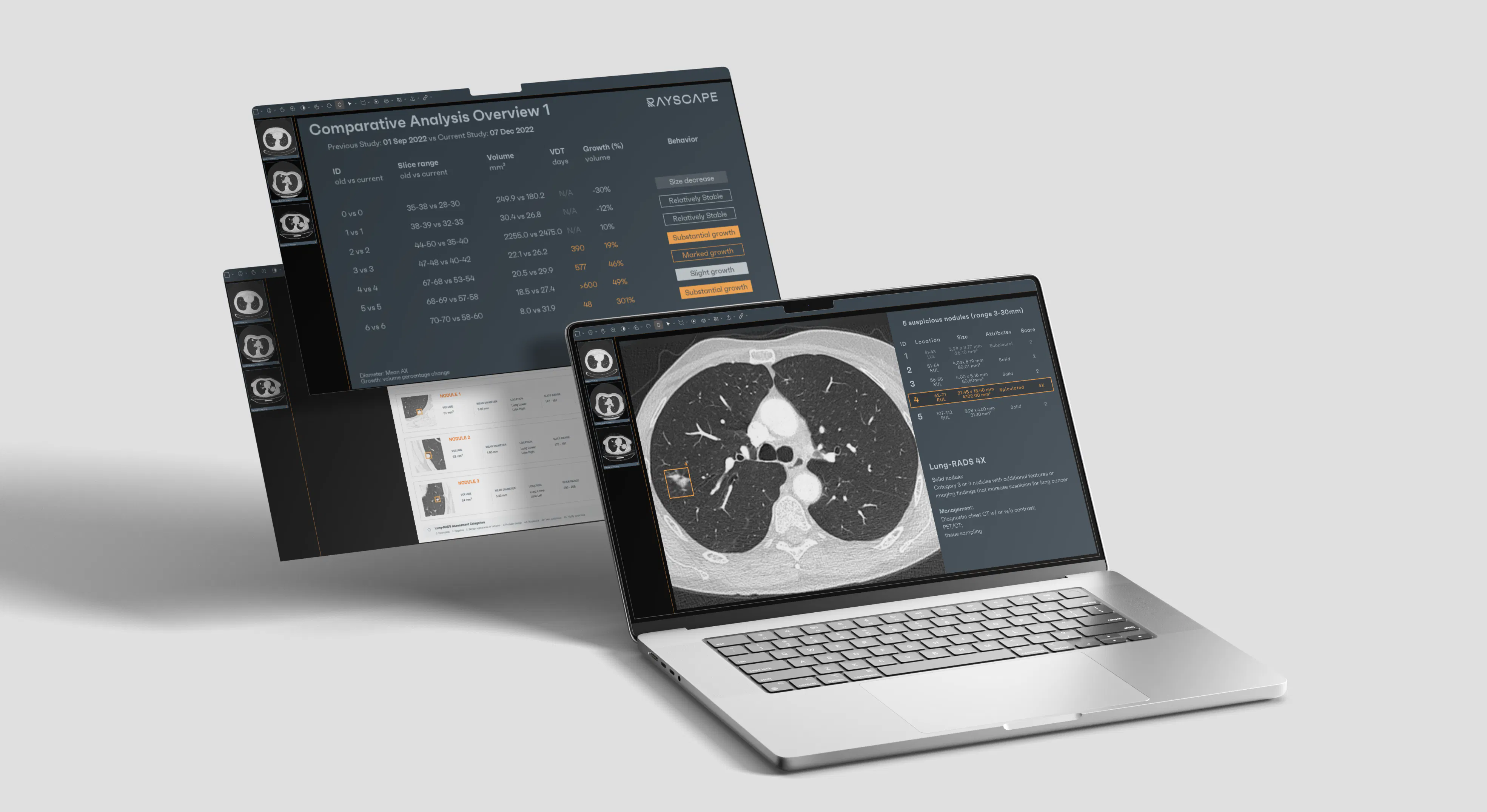

Discover how Rayscape works
integrate Rayscape AI into
your hospital's infrastructure
and improve both your
daily workflow and patients' experience.
