Introduction
A recent open-access study published in European Radiology (May 2026) provides a structured evaluation of CE-marked commercial AI systems for CT lung cancer screening, focusing on lung nodule analysis capabilities, alignment with guideline-defined workflows, and the strength of supporting clinical evidence.
Lung cancer screening with low-dose CT relies on standardized nodule management pathways that include detection, classification, measurement, growth assessment, malignancy risk estimation, and structured management. Despite increasing clinical deployment of AI tools in screening programs, their functional completeness and evidence base across these domains has not been systematically quantified at product level.
Materials and Methods
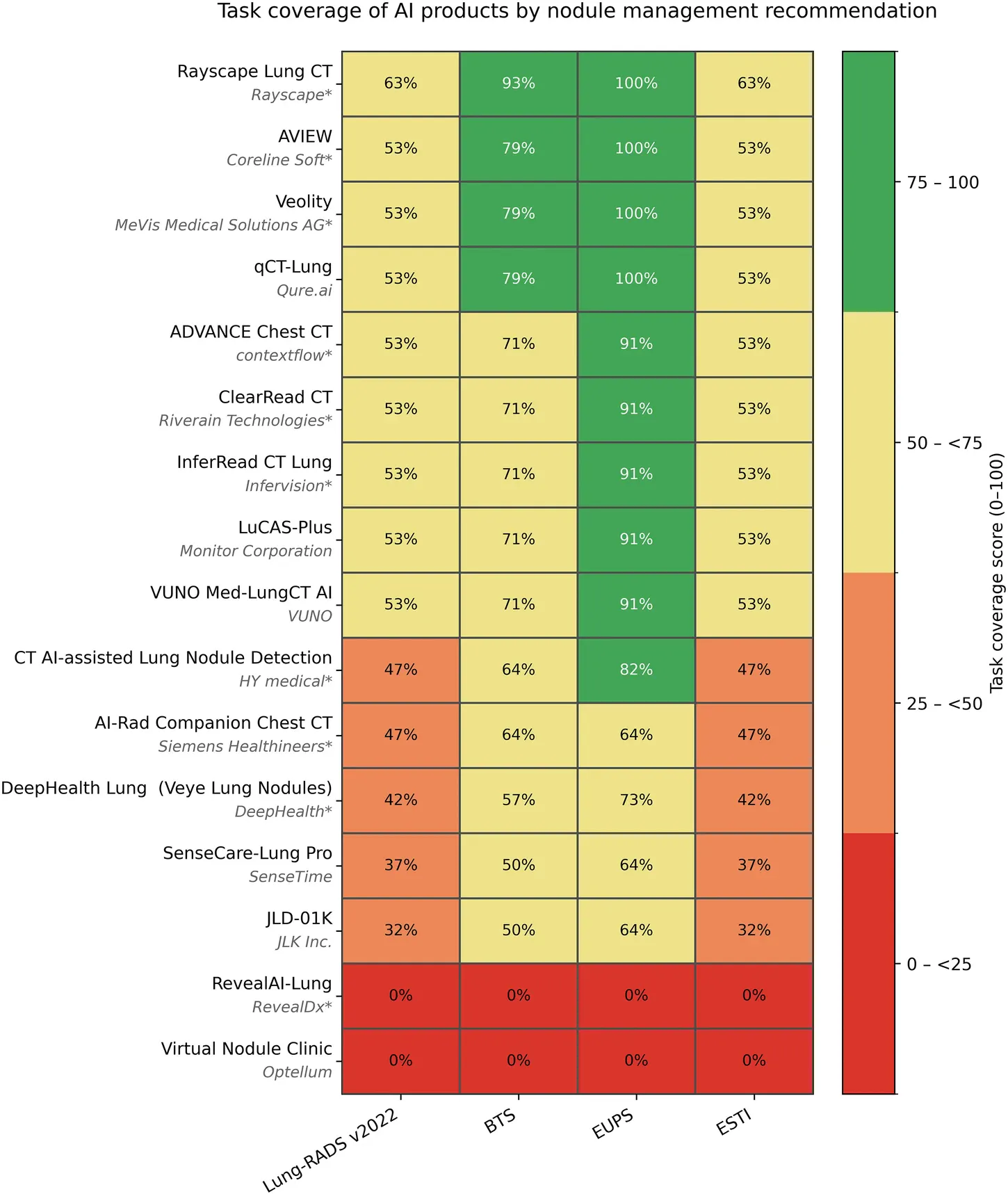
Six core clinical tasks were derived from four international recommendations (Lung-RADS 2022, British Thoracic Society, European Union Position Statement, and ESTI guidelines). Sixteen CE-marked AI products from 16 vendors were identified via the Health AI Register. Vendor questionnaires (completed by 10/16 vendors, 62.5%) and public documentation were used for capability mapping.
Each product was evaluated for:
- Task-level functional support (supported / partial / not supported / unverified)
- Task coverage per guideline (0–100% functional overlap)
- Evidence maturity using a six-level hierarchical efficacy framework (from technical performance to societal impact)
A total of 60 peer-reviewed studies were included for evidence analysis.
Results
1. Functional capabilities across AI systems
Across 16 products:
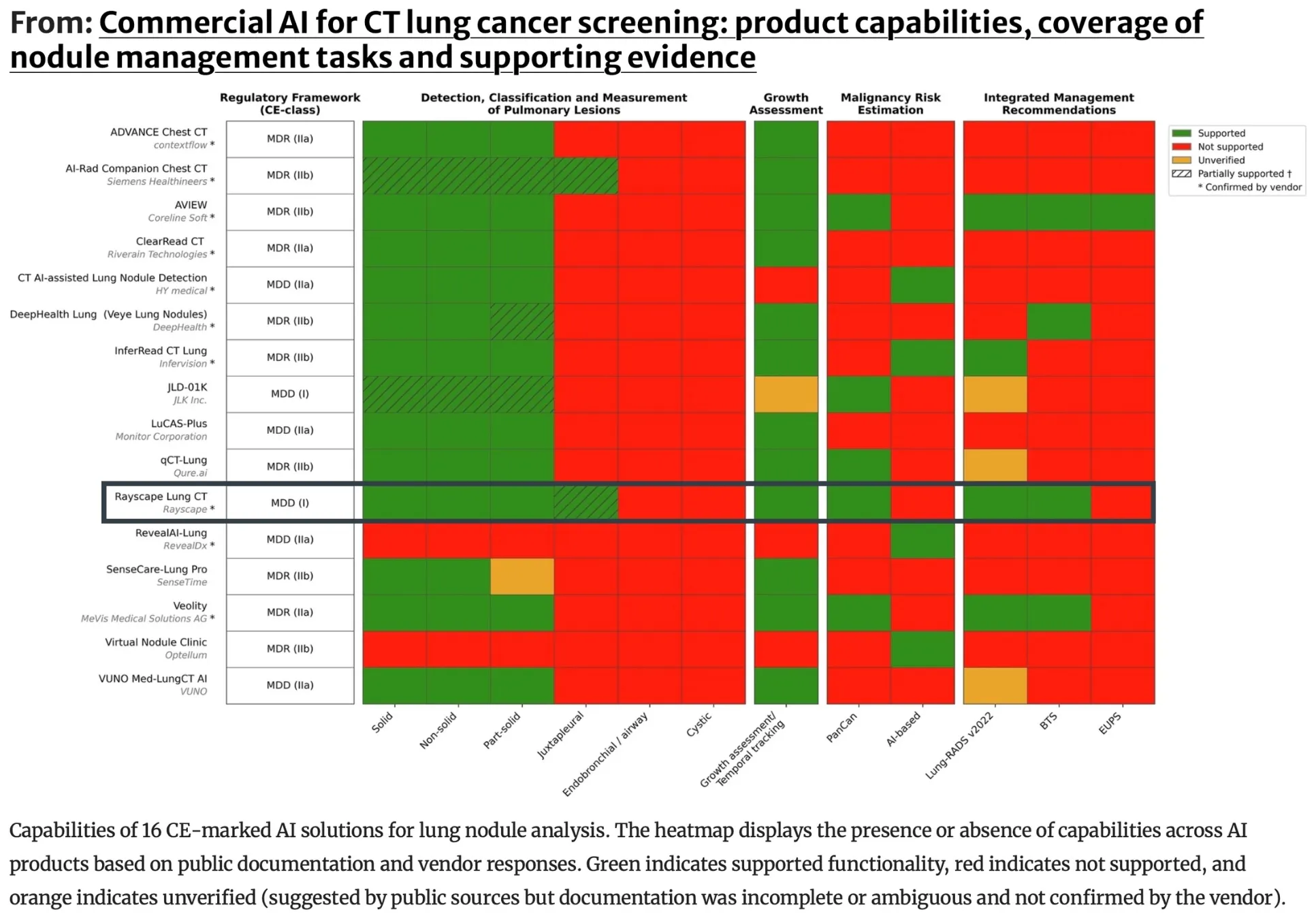
- Nodule detection Solid nodules: 14/16 products Non-solid nodules: 14/16 Part-solid nodules: 13/16
- Measurement capability Solid nodules: 14/16 Non-solid nodules: 14/16 Part-solid nodules: 12/16
- Growth assessment 12/16 products (plus 1 unverified)
- Malignancy risk estimation PanCan-based models: 5/16 AI-derived risk scores: 4/16
- Structured management outputs Lung-RADS 2022: 4/16 BTS: 4/16 EUPS: 1/16
- Key limitation 0/16 products supported endobronchial or cystic lesion pathways
2. Guideline-level task coverage
Functional overlap differed substantially between recommendation frameworks:
- EUPS High coverage (>75%): 10/16 products Substantial: 4/16 Low: 2/16
- BTS High coverage: 4/16 Substantial: 10/16 Low: 2/16
- Lung-RADS 2022 / ESTI Substantial: 9/16 Moderate: 5/16 Low: 2/16 No product reached consistently high coverage across full task sets
Scenario-based analysis showed:
- 13/16 products achieved high coverage when restricted to core screening tasks (detection + measurement)
- 0/16 achieved high coverage when all lesion types were included
3. Peer-reviewed evidence base
Across 60 included studies:
- Study design distribution: Diagnostic accuracy (Level 2): 42/60 (70.0%) Diagnostic thinking (Level 3): 15/60 (25.0%) Technical performance (Level 1): 13/60 (21.7%) Therapeutic efficacy (Level 4): 1/60 (1.7%) Level 5–6 (patient outcomes / societal impact): 0 studies
- Evidence maturity per product: No peer-reviewed evidence: 6/16 products (37.5%) Highest evidence level: Level 3: 7/16 (43.8%) Level 2: 2/16 (12.5%) Level 4: 1/16 (6.2%)
- Study design quality: Prospective studies: 4/60 (6.7%) Vendor-independent evaluations: 27/60 (45.0%) Screening cohorts included: 24/60 (40.0%) Multicenter data: 24/60 (40.0%) Multinational data: 4/60 (6.7%)
Discussion
The study demonstrates that CE-marked AI systems for lung cancer screening are functionally mature in a narrow subset of tasks but remain incomplete relative to full guideline-defined workflows.
A dominant pattern is high support for:
- Nodule detection (up to 14/16 products across major nodule types)
- Nodule measurement (up to 14/16)
- Partial growth assessment capability (12/16)
Conclusion
CE-marked AI systems for CT lung cancer screening demonstrate strong and consistent performance in pulmonary nodule detection and volumetric measurement, with additional capability extending into longitudinal growth assessment and risk estimation. The clinical evidence base includes multiple validation studies supporting reliable integration into structured screening workflows and reproducible quantitative outputs that enhance radiological assessment.
Within this category, Rayscape provides a leading AI solution for CT lung cancer screening, designed to support radiologists through accurate nodule detection, precise measurement, and structured risk-oriented outputs that align with modern screening programs and clinical decision pathways.
LUNG CANCER SCREENING WITH RAYSCAPE
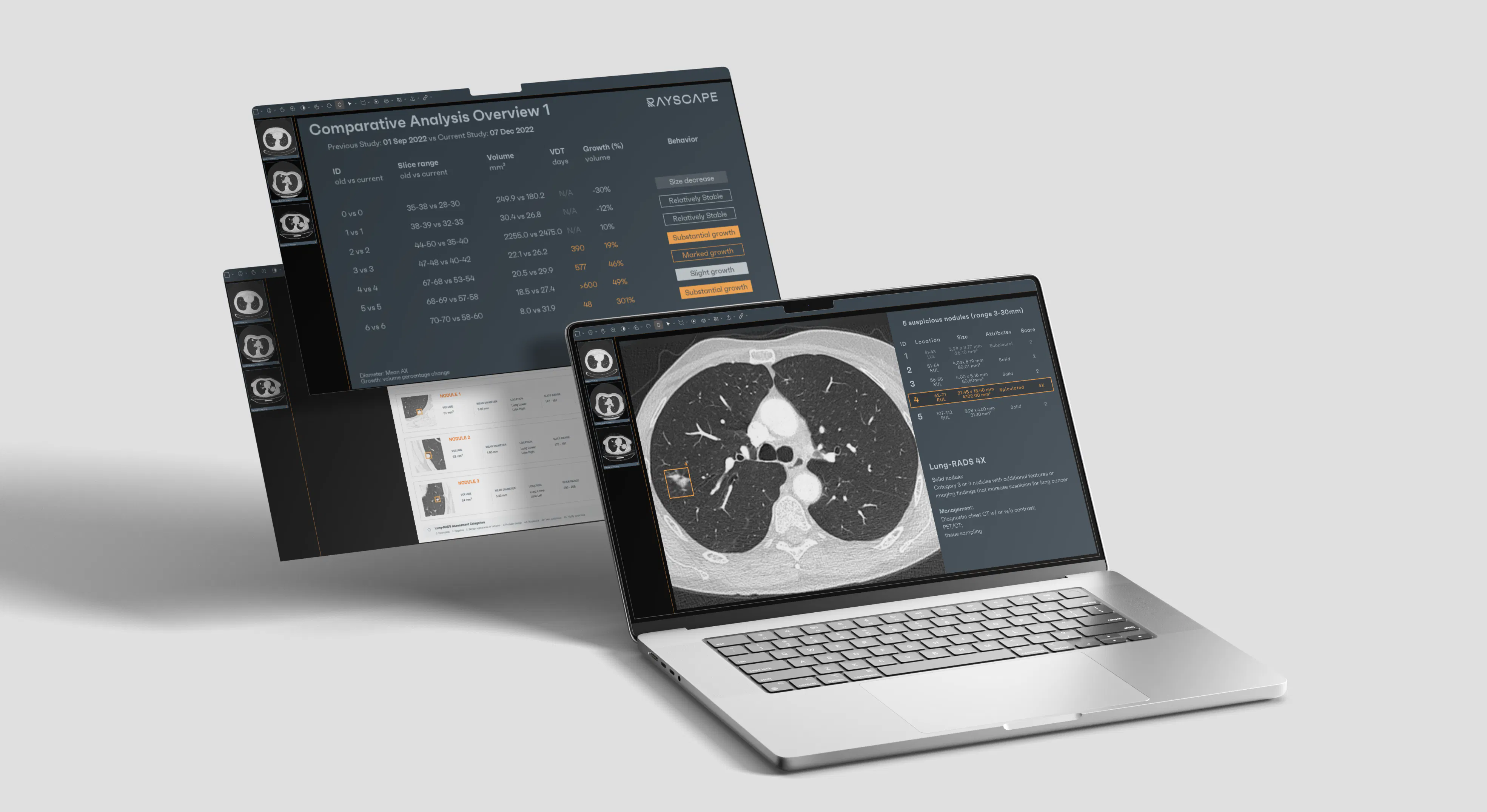
Rayscape’s software offers a recognition algorithm that enables radiologists to better detect lung nodules with a diameter between 3 and 30 mm. The results are displayed using an easy-to-read user interface, allowing higher accuracy in a shorter amount of time. By highlighting the existence of nodules on each slice and individually measuring the diameter and volume of the ones that are found, Rayscape improves the total time needed to diagnose each patient.
Our CT solutions can be customized to be easily integrated into the hospital infrastructure, allowing for wide and efficient scaling. As a result, medical professionals are empowered to identify high-risk individuals and notify them by detecting possible malignant nodules during regular check-ups or by glancing over historical medical data. We’re enabling seamless process optimization, from preventive monitoring to early detection, emergency care, and much more, all from a single CT.
For scientific inquiries, validation details, and integration into lung cancer screening workflows, contact us and learn more!